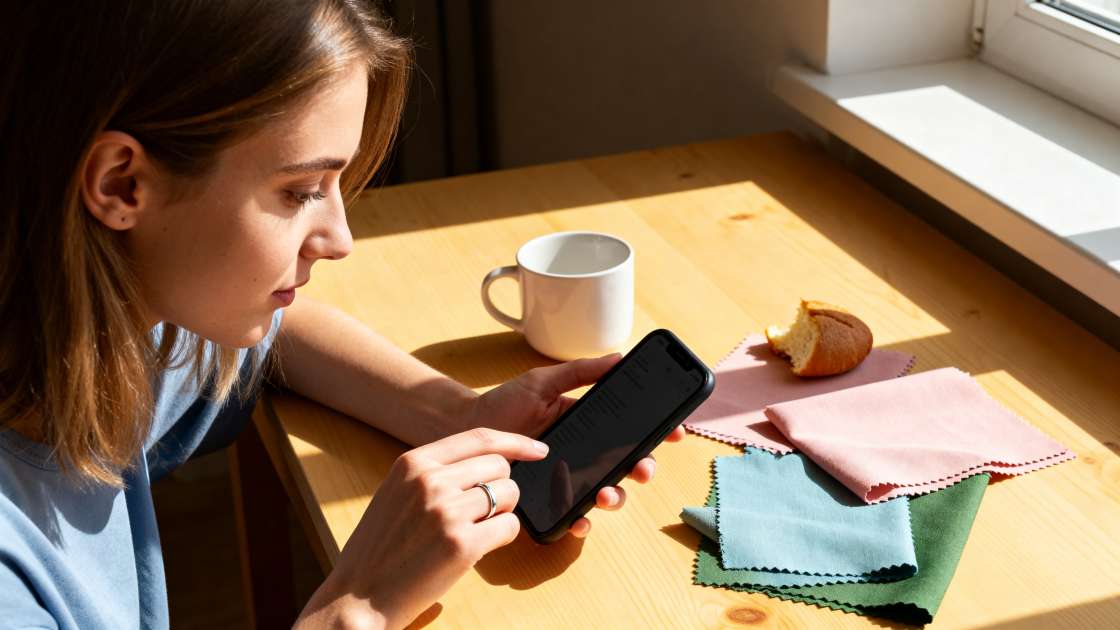
I was standing in front of my closet last Tuesday morning, staring at a row of shirts I've owned for years, and realized I couldn't answer a stupidly simple question: what colors actually look good on me? Not "fine" or "okay," but genuinely flattering. I own three shades of blue that all seemed like a good idea in the store, and now they just hang there, mocking my indecision. Somewhere between scrolling through yet another style forum and questioning my life choices, I stumbled onto this modern solution everyone's talking about: AI color analysis from a single photo. Upload a selfie, get your palette in seconds, supposedly unlock the secret code to looking put-together. The promise is seductive. But here's the real question that made me dig into this whole thing: are these digital tools actually a revolutionary shortcut to discovering what suits you, or are they just another tech gimmick that sounds smart but delivers party-trick accuracy?
Вкратце: AI tools analyze your selfie to suggest a color palette in seconds, but accuracy depends entirely on photo quality and lighting. Best feature: free, instant guidance for shopping. What to prep: a makeup-free face and access to natural window light. Daily budget: irrelevant, most tools are free or under ten bucks. Main tip: treat the result as inspiration, not gospel, and test multiple photos to check consistency.
What Is AI Color Analysis and How Does It Work?
At its core, AI color analysis is software examining your uploaded photo and spitting out a verdict on which color "season" you belong to, along with a matching palette of flattering shades. The actual process is deceptively simple, which is part of the appeal and also part of the problem. You snap a selfie, ideally with no makeup, standing in natural daylight that's bright but not harsh. You upload it. Then you wait anywhere from five seconds to a couple of minutes while the algorithm does its thing.
What the AI is scanning for is a handful of key visual markers. It's identifying your skin undertone, trying to decide if you skew warm, cool, or somewhere in the neutral middle. It's measuring the contrast level between your skin, hair, and eyes—high contrast gets you pushed toward one category, low contrast toward another. It's also registering the specific shades: are your eyes hazel or deep brown, is your hair ash or golden, does your skin have pink or yellow undertones. All of this gets fed into a pattern-matching engine that maps you onto a seasonal framework—Spring, Summer, Autumn, Winter, sometimes with subdivisions like "Warm Spring" or "Cool Winter." You get a digital palette with swatches for clothing, makeup, accessories. The whole thing feels sleek and scientific.
Except it's not really scientific. It's pattern recognition applied to a classification system that was always more art than hard data. The AI isn't measuring wavelengths or pigment density. It's guessing which box you fit into based on how your pixels compare to its training data. That's fine when the photo is clean and the lighting is neutral, but the moment any variable goes sideways, the guess gets shakier.
The Pros: Why AI Color Analysis Is So Popular
The biggest selling point is speed, and I mean that literally. Most of these tools return a result before you've had time to second-guess uploading the photo. Seconds, maybe a minute if the server is slow. Compared to booking an appointment with a color consultant, driving somewhere, sitting through an hour-long draping session with fabric swatches, this feels like magic. You get an answer right now, on your couch, in your pajamas.
Then there's cost. A professional color analysis session can run you anywhere from a hundred to several hundred bucks depending on where you live and who you book. AI tools are often free, or they charge five to ten dollars for a detailed report. That democratizes the whole concept. Suddenly anyone with a phone can get style advice that used to require disposable income and free time. For someone like me, who's curious but skeptical about spending serious money on something I might dismiss as nonsense, the low barrier to entry is a big draw.
It also functions as a decent starting point if you're genuinely clueless. I had no framework for thinking about color before this. Warm versus cool undertones sounded like astrology. The AI gave me a palette, and even if it's not perfect, it's something to work from. I can walk into a store, pull out my phone, compare a shirt to the digital swatches, and at least narrow down my options instead of buying another blue that looks identical to the three I already regret.
There's also this weird sense of objectivity people feel with these tools. You're not answering quiz questions like "Do you look better in gold or silver jewelry?" where your answer might be based on what you want to believe rather than what actually flatters you. The AI is looking at your face, analyzing your features, delivering a verdict based on the image itself. That feels more trustworthy to some users, even though the algorithm is still working with a lot of assumptions and a single snapshot.
The Cons: Why It's Still a 'Pretty Guess'
Here's where the whole thing starts to fall apart if you're not careful. The AI's accuracy is almost entirely dependent on the quality of the photo you feed it, and "quality" here doesn't just mean resolution. It means lighting, background, makeup, hair color, camera settings, even the color calibration of your phone screen. This is classic garbage-in, garbage-out territory. If your selfie is taken under warm indoor light—say, a standard household bulb with a yellowish cast—the AI might read your skin as warmer than it actually is and push you toward Autumn when you're really a Summer. If there's a shadow across half your face, the contrast analysis goes sideways.
Heavy makeup is another landmine. Foundation, blush, contouring—they all mask your natural skin tone, which is exactly what the AI is trying to analyze. Dyed hair, especially if it's far from your natural shade, throws off the hair color reading. A brightly colored wall behind you can reflect light onto your skin and shift the perceived undertone. I tried one tool twice: once in front of a beige wall under midday window light, once in my kitchen under overhead LEDs with a blue backsplash visible. Got two different seasonal classifications. Same face, same day, fifteen minutes apart.
The deeper issue is that the AI isn't performing a scientific measurement. It's not using a spectrophotometer to read your melanin levels. It's doing pattern-matching against a dataset of images it was trained on, trying to fit you into predefined buckets like "Cool Winter" or "Warm Spring." Those buckets themselves are a simplification of the huge spectrum of human coloring. The whole seasonal color theory framework is already an abstraction, a useful shorthand but not a natural law. So the AI is approximating your placement within an already approximate system. It's a guess on top of a stylized model.
How to Get the Most Accurate Result from an AI Tool
If you're going to do this, you might as well maximize your chances of getting a useful answer instead of a random dice roll. The photo you upload matters more than anything else, so treat it like a small science experiment. Find a window with good natural light—ideally mid-morning or mid-afternoon when the sun is bright but not directly blasting your face. You want indirect, even illumination. Stand facing the window so the light hits you straight on, not from the side where it creates shadows.
Strip your face down to bare skin. No foundation, no blush, no tinted moisturizer, no lip color. If you have dyed hair that's dramatically different from your natural shade—like bleached platinum when you're naturally dark brown—pull it back and out of the frame as much as possible, or at least away from your face so it's not reflecting color onto your skin. The AI needs to see your actual coloring, not the version you've constructed with products.
Background matters more than you'd think. Stand in front of a plain white or light gray wall. Avoid anything with color—no red brick, no green plants, no blue paint. Those hues can bounce light onto your skin and skew the reading. Also, use your phone's main rear camera if you can instead of the front-facing selfie cam, since the rear camera usually has better sensors and more accurate color capture. Definitely turn off any beauty modes, filters, or auto-enhancements. You want the rawest, most neutral image possible.
My recommendation: take three or four photos under these conditions, maybe at different times of day, and run them all through the same tool. If you get the same result each time, you've probably got something reliable. If the answers are all over the map, your lighting or setup still needs work, or the tool itself is just inconsistent. You can also try the same photo across two or three different AI services and see if they agree. Consistency across multiple tests is your best indicator of accuracy.
AI Analysis vs. Professional Draping: A Comparison
If you're trying to decide whether AI analysis is enough or if you should shell out for a professional session, here's how they stack up in practice. I'm not going to pretend they're equivalent experiences.
| Feature | AI Color Analysis | Professional In-Person Draping |
| Cost | Free or under $10 for most tools | $100 to $300+ depending on consultant and location |
| Time and Effort | Seconds to minutes, done from your phone at home | Requires booking, travel, and a session lasting one to two hours |
| Accuracy | Variable, heavily dependent on photo quality and lighting conditions | High, based on real-time observation and physical fabric draping in controlled lighting |
The fundamental difference is that a professional is watching how actual fabric colors reflect onto your skin in real time. They're holding up drapes in controlled, neutral lighting and observing which shades make your complexion look clear and vibrant versus dull or sallow. They can see subtle shifts the AI will never catch—how a particular shade of red brings out warmth in your cheeks, or how a cool gray makes your eyes pop. They can also talk to you, ask questions, account for your personal preferences and lifestyle. An AI tool gives you a static palette based on a single frozen image. A consultant gives you a nuanced, interactive assessment with physical swatches you can take home and reference when shopping.
That said, not everyone needs that level of detail or wants to spend the money. If you're just looking for general guidance and you're comfortable experimenting, the AI is a solid starting point. If you're serious about refining your style, willing to invest, and you want a definitive answer you can rely on for years, book the professional.
Final Verdict: A Useful Tool, Not the Absolute Truth
After digging into this and testing it myself multiple times with varying photo conditions, here's where I landed: AI color analysis is a genuinely useful, convenient tool for inspiration and as a starting point, but it's not the final word on what suits you. It's a well-informed guess at best, and the accuracy of that guess depends almost entirely on how good your photo is and how well the lighting captures your actual coloring.
It's great for beginners who have no idea where to start with color. It's great for anyone who wants quick shopping guidance without spending money on a consultant. It's great if you're curious about color theory and want a low-commitment way to explore it. You get a palette, you experiment, you see what works. That's valuable.
It's not great if you're expecting a definitive, personalized, deeply nuanced analysis. It's not great if you upload a poorly lit selfie with makeup and dyed hair and then get frustrated when the result doesn't match reality. It's also not great if you treat the seasonal classification as a rigid rule instead of a flexible suggestion. The AI is giving you a map, not a commandment.
Use it to open the door to new colors you might not have considered. Use it to narrow down your options when you're standing in a store overwhelmed by racks of clothing. But use your own eyes and your own gut as the final judge. If a color makes you feel confident and alive when you put it on, that's the most important analysis you'll ever get, algorithm or not.